
Checking Criminal History in Niagara County
No single Niagara County criminal record search covers arrest reports, jail custody, court filings, and the official state rap sheet. Begin with the event or document, not just a name. The sheriff's current-custody and warrant feeds answer narrow status questions. The originating police agency holds its report. City, town, and county clerks control their own case files. New York State then offers separate court-history and fingerprint products.
The Niagara County Clerk's official page shows where county-level court records are handled. Its first-floor counter at 175 Hawley Street in Lockport is open weekdays from 9 a.m. to 5 p.m., and the criminal-record request form supports a certificate of disposition, docket summary, or named document.
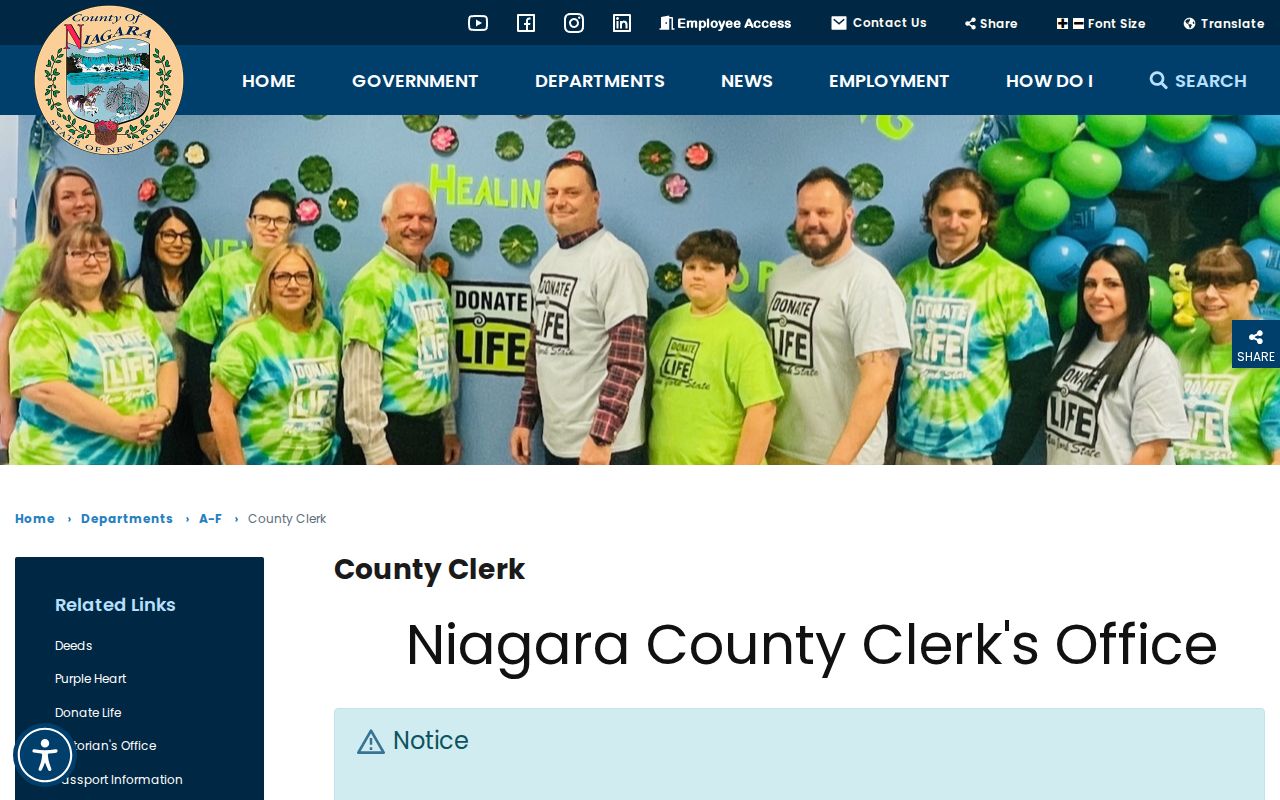
The clerk image marks the Niagara County case route. Local Niagara County City and Town Court files still remain with the court that heard the matter.
- Identify whether the needed item is a police report, booking entry, warrant, court file, or personal state record.
- Search the sheriff for present custody or warrants, then call the listed unit when the feed is unclear.
- Match a filed case to the correct City, Town, County, or Supreme Court clerk.
- Request the court's disposition certificate or docket summary when the final result matters.
- Use DCJS fingerprint review for one's own official New York history and challenge errors with court proof.
Four Niagara County Criminal Record Systems
Niagara County criminal history lives in four main systems. The sheriff creates or keeps patrol reports, warrant information, booking data, and present county custody. New York courts preserve accusatory papers, appearances, pleas, motions, dispositions, and sentences. The New York State Division of Criminal Justice Services links fingerprint-supported arrest cycles to reported prosecutor and court outcomes. The New York State Department of Corrections and Community Supervision adds state-prison and parole information.
These Niagara County systems answer different questions. A Niagara County jail card is not a lifetime record. A Niagara County court file is richer about litigation but limited to one venue. A DCJS response is the subject's official New York rap sheet, yet it excludes federal and out-of-state history. A DOCCS result concerns state custody, not the Niagara County Correctional Facility.
| Source | Best use | Key limit |
|---|---|---|
| Niagara County Sheriff | County reports, custody, warrants | Not a conviction history |
| New York courts | Filed case and disposition | Venue-specific files |
| DCJS | Own fingerprint-linked New York history | Not open to third parties |
| DOCCS | State prison and parole status | No county-jail data |
New York Official Background Checks
The DCJS personal Record Review is the official fingerprint-based New York criminal-history product. It is only for the person whose prints are submitted. An IdentoGO appointment uses service code 15464Z for a suppressed response or 15465F for an unsuppressed response. The published processing fee is $17.50, and DCJS mails the answer in about three to four weeks. DCJS histories cannot be obtained through FOIL.
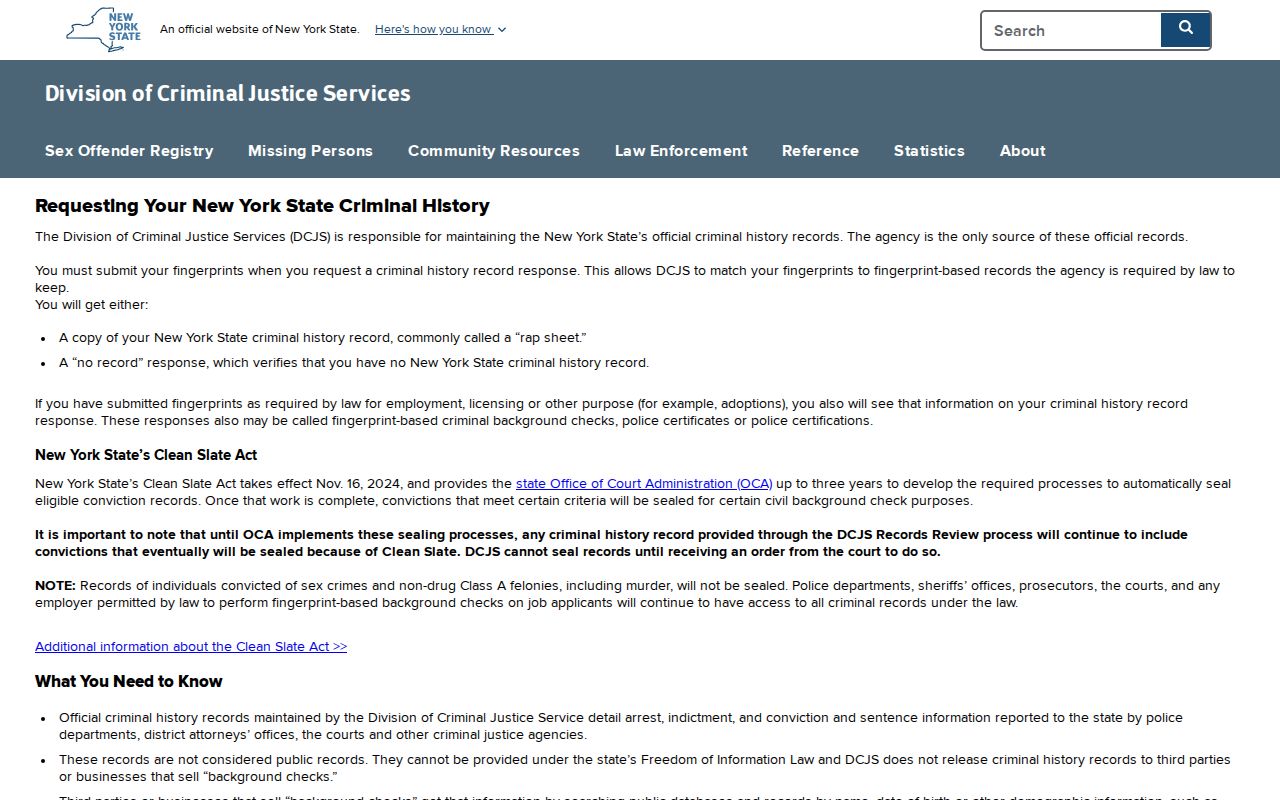
The DCJS page is the proper starting point for reviewing one's own fingerprint-supported record. Its packet also gives instructions for disputing missing or incorrect information.
The separate OCA Criminal History Record Search, or CHRS, costs $95 per exact name and date of birth. It reports qualifying public pending matters and convictions from New York courts, subject to sealing and OCA nondisclosure rules. It is not fingerprint verified and is not a certified disposition.
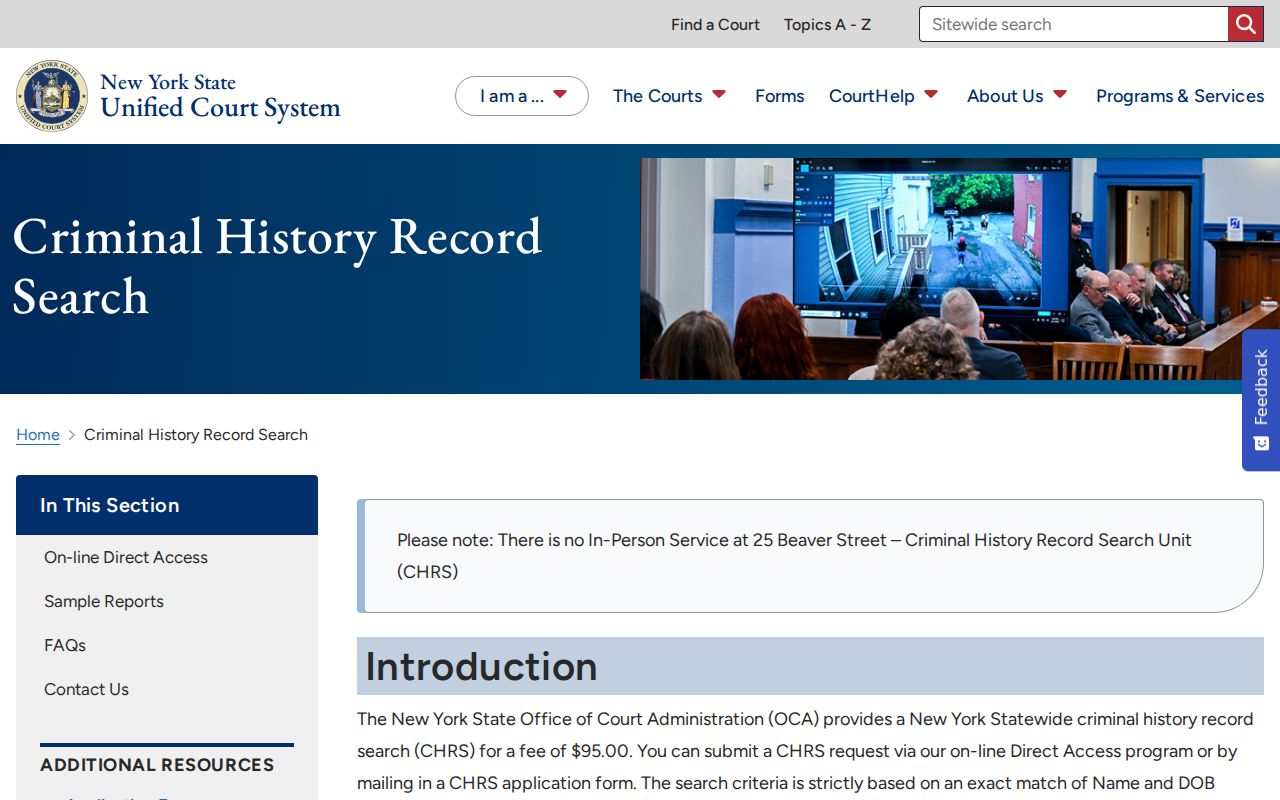
OCA's product fills the public statewide court-search role, while the originating Niagara County court supplies certified proof.
| Product | Identity method | Fee |
|---|---|---|
| DCJS Record Review | Fingerprints through IdentoGO | $17.50 |
| OCA CHRS | Exact full name and date of birth | $95 per search |
| FBI Identity History Summary | Fingerprints, self-review only | $18 plus capture costs |
| Niagara disposition certificate | One identified county case | $5 |
Niagara County Criminal Cases at Hawley
The Niagara County Courthouse at 175 Hawley Street concentrates the County Clerk, District Attorney, County Court, and Supreme Court in one building. The offices remain distinct. Call the County Clerk at 716-439-7022 for county-level case copies and the Unified Court System clerk at 716-280-6400 for court scheduling or court-office questions. A second Supreme and County Court location operates at 775 Third Street in Niagara Falls.
The County Clerk's official form asks for as many of these items as possible: defendant name, indictment number, arrest date, charges, conviction date, sentence date, and ticket number. A certificate of disposition and a docket summary each cost $5. The price for a specific document depends on page count, so the clerk asks requesters to call before sending payment.
County Clerk
175 Hawley Street, first floor
Lockport, NY 14094
716-439-7022
Weekdays, 9 a.m.-5 p.m.
Sheriff and Jail
5526 Niagara Street Extension
Lockport, NY 14094
716-438-3393
Administration, 8 a.m.-4:30 p.m.
Criminal Record Types
A Niagara County criminal record may describe one stage rather than the whole matter. Police reports contain an agency's narrative and arrest basis. Jail records document intake and current custody. Court files track accusations as filed, later motions, disposition, and sentence. Warrants are orders that require direct confirmation, while probation, parole, and registry data operate under their own access rules.
- Arrest and incident records: request them from the police agency that created them.
- Booking and custody records: use the Niagara County Sheriff for county detention.
- Court case files: contact the clerk for the court that heard the case.
- Rap sheets: obtain one's own official New York history through DCJS fingerprints.
- State custody records: use DOCCS for prison and community-supervision data.
The Niagara County District Attorney explains the prosecution office's county role.
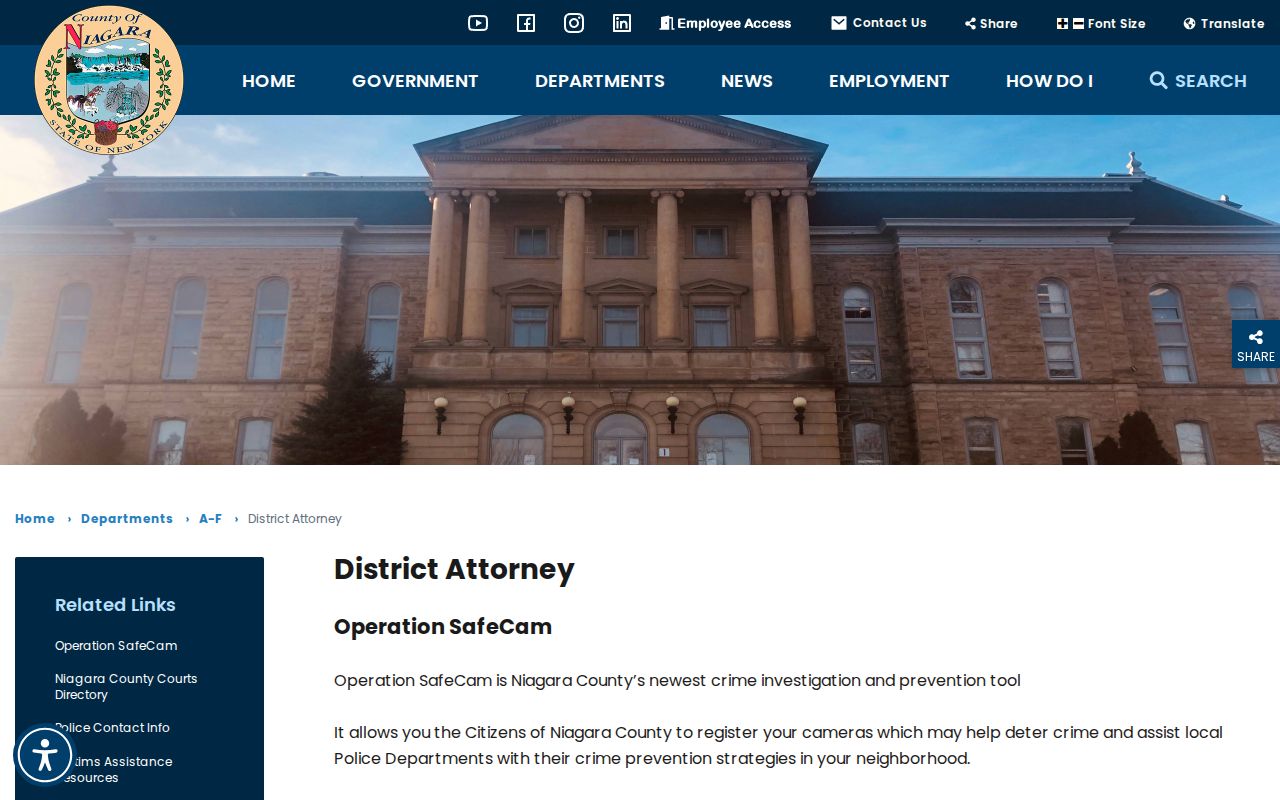
The Niagara County district attorney image connects Niagara County arrest allegations to the charging decision, which may differ from the charge shown at booking.
Niagara County Criminal Custody Dashboard
The Niagara County Sheriff's official site links current incarcerated individuals, warrants, weekly arrest blotters, press releases, and an OCV mobile access page. The current-custody interface has one live text filter labeled “Search...” and person cards. It does not advertise date, booking-number, charge, or status filters. Call Jail Information at 716-438-3446 when the list does not resolve a current match.
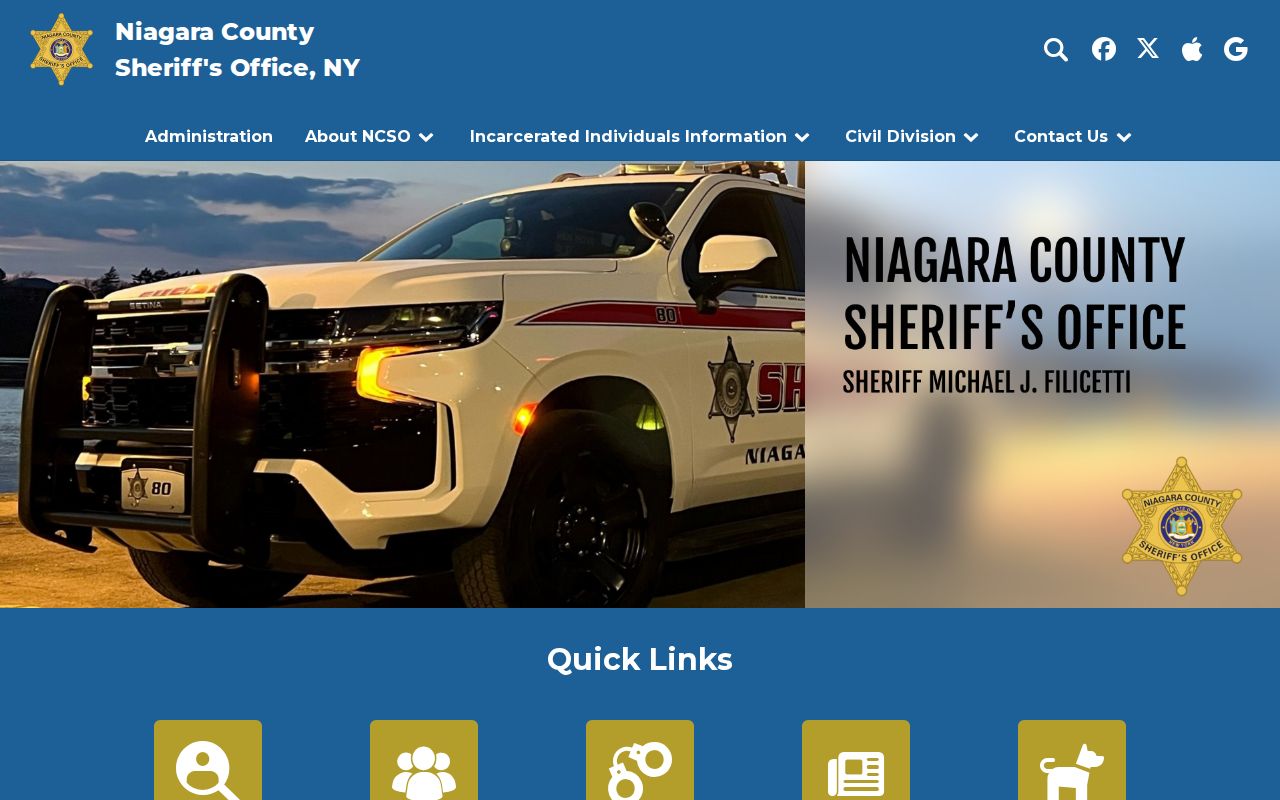
The Niagara County sheriff image points to the correct county custodian, not a commercial booking gallery. A listed person is in current Niagara County custody; the Niagara County listing is not proof of guilt or a complete criminal history.
The OCV app at the sheriff's official app share page is an access shortcut for the same agency channels. It does not create a new record system or turn city police reports into sheriff records.
Note: Release from the county jail changes custody status, but it does not decide or erase the related criminal case.
Niagara County Criminal Warrant Checks
The sheriff's Niagara County warrant feed is a useful first check, but it is not a court-certified response. Its vendor-fed list uses a text-filter pattern, and the research did not establish a complete published field inventory. Call the dedicated Warrants line at 716-438-3344 before relying on a possible match or taking action. The sheriff can confirm its own channel and explain the safe next step.
Issuing courts are the second half of the check. A bench warrant from a City or Town Court may not appear where a reader expects, and the Niagara County court directory lists County Court, three City Courts, and eleven Town Courts. Contact the clerk for the court named on prior paperwork when that venue is known. Court staff control the case file, while the sheriff controls its public warrant list and enforcement information.
If a warrant concerns the reader, avoid appearing at an office without first asking the sheriff, the court, or a New York attorney how to proceed. A public list can lag a new order, recall, or court update.
Inside a Niagara County Criminal Record
The fields depend on the source. A DCJS record is organized around identity and fingerprint-supported arrest cycles. A court file adds the accusatory instrument, appearances, motions, pleas, judgment, and sentence. A jail entry is a custody snapshot. Matching names across those sources is useful, but their identifiers are not interchangeable.
| Name and identifiers | Legal names, aliases, date of birth, a court docket, NYSID, or DOCCS DIN, depending on the system. |
|---|---|
| Arrest and booking data | Arresting agency, intake date, initial charges, bail, and custody status. |
| Charges and statutes | Alleged offenses at arrest and any later prosecutor or court changes. |
| Disposition | Pending, conviction, dismissal, acquittal, or another final court result. |
| Sentence | Jail, prison, probation, fine, discharge, or other court-ordered terms. |
| Custody or supervision | County jail status, DOCCS confinement, parole, or locally administered probation. |
- Disposition
- The court's final result for a charge or case.
- NYSID
- New York's identifier for a fingerprint-supported criminal-history identity.
- DIN
- The Department Identification Number assigned to a DOCCS commitment.
- Certificate of disposition
- The court-certified statement of a case outcome.
Niagara County Jail or State Prison
Use Niagara County's custody list for the county correctional facility. Use the DOCCS Incarcerated Lookup for New York state prison. The state search accepts identifying information such as name or a known DIN, then returns eligible custody and release data. It does not search the Lockport county jail.
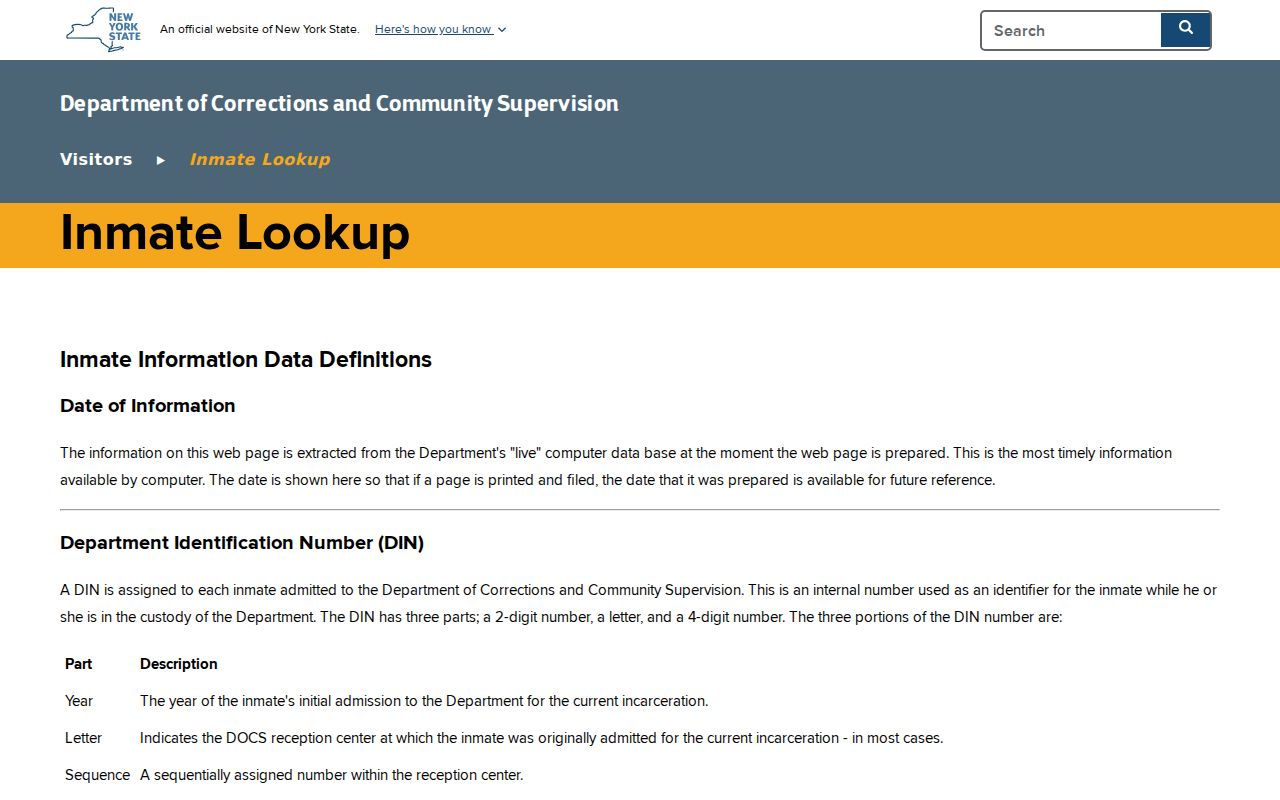
The incarcerated-lookup image represents the state layer. Federal custody uses the Bureau of Prisons locator, while federal case files for Niagara County fall within the Western District of New York.
DOCCS also publishes a separate Parolee Lookup. It can be searched by NYSID, DIN, name, or name with birth year, and an active result may list the assigned area office.
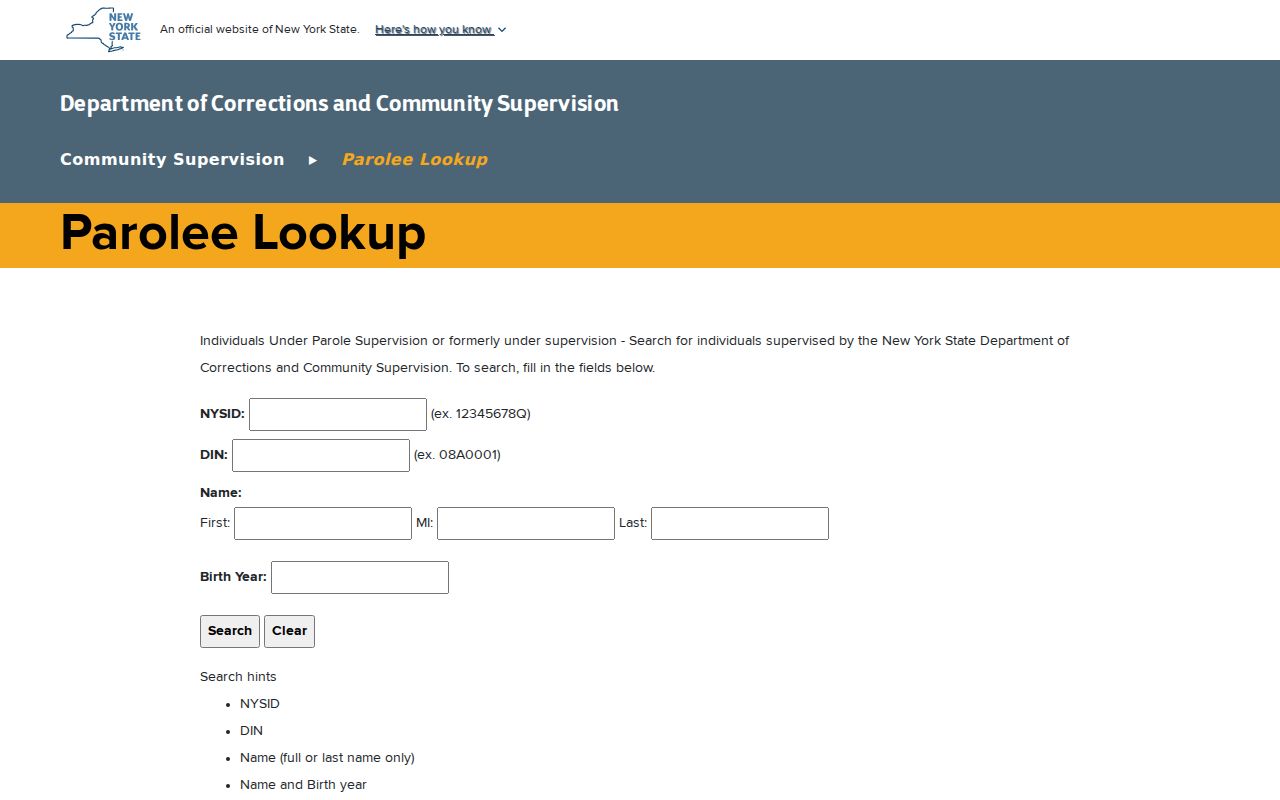
The parole image highlights a separate supervision channel. Niagara County Probation handles local probation sentences, and no statewide public probationer name search exists.
Public Access Laws in New York
Public access in Niagara County turns on both the record's custodian and its governing law. FOIL creates a route to agency records but allows redaction or withholding for active investigations, privacy, safety, and other statutory grounds. Court clerks have separate duties to search and copy accessible court files. Neither route opens another person's confidential DCJS rap sheet.
Key New York laws:
Public Officers Law Article 6 establishes FOIL requests, exemptions, and appeals.
Executive Law §837 establishes DCJS collection duties without making rap sheets public.
CPL §160.59 governs applications to seal certain older convictions.
CPL §160.57 directs Clean Slate sealing for eligible convictions.
Niagara County Criminal Offense Classes
New York Penal Law §55.05 divides felonies into classes A-I, A-II, B, C, D, and E. Niagara County Court or Supreme Court handles the felony trial file, although a City or Town Court may hold the first arraignment and preliminary proceeding. The charge class can help route a Niagara County criminal case, but it does not reveal the final sentence by itself.
Class A and B misdemeanors, unclassified misdemeanors, and violations ordinarily remain in Niagara County's local criminal courts when committed within their jurisdiction. A violation is not classified as a crime under New York's scheme. The misdemeanor sentencing statute gives the baseline confinement limits, while the law that defines an unclassified misdemeanor supplies its penalty.
Read the filed statute, degree, class, disposition, and sentence together. Violent-felony, drug, sex-offense, and repeat-offender provisions can change the ordinary felony baseline in Penal Law §70.00. A Niagara County jail intake charge can also differ from the charge that prosecutors file or the offense of conviction.
Niagara County Criminal Records by FOIL
Use FOIL when an agency record is not available through a direct public channel. The Niagara County FOIL page directs the completed form to the County Legislature at 175 Hawley Street. A strong request names the record category, agency, incident date and approximate time, location, known report number, and preferred format. The office need not create a new record to answer a question.
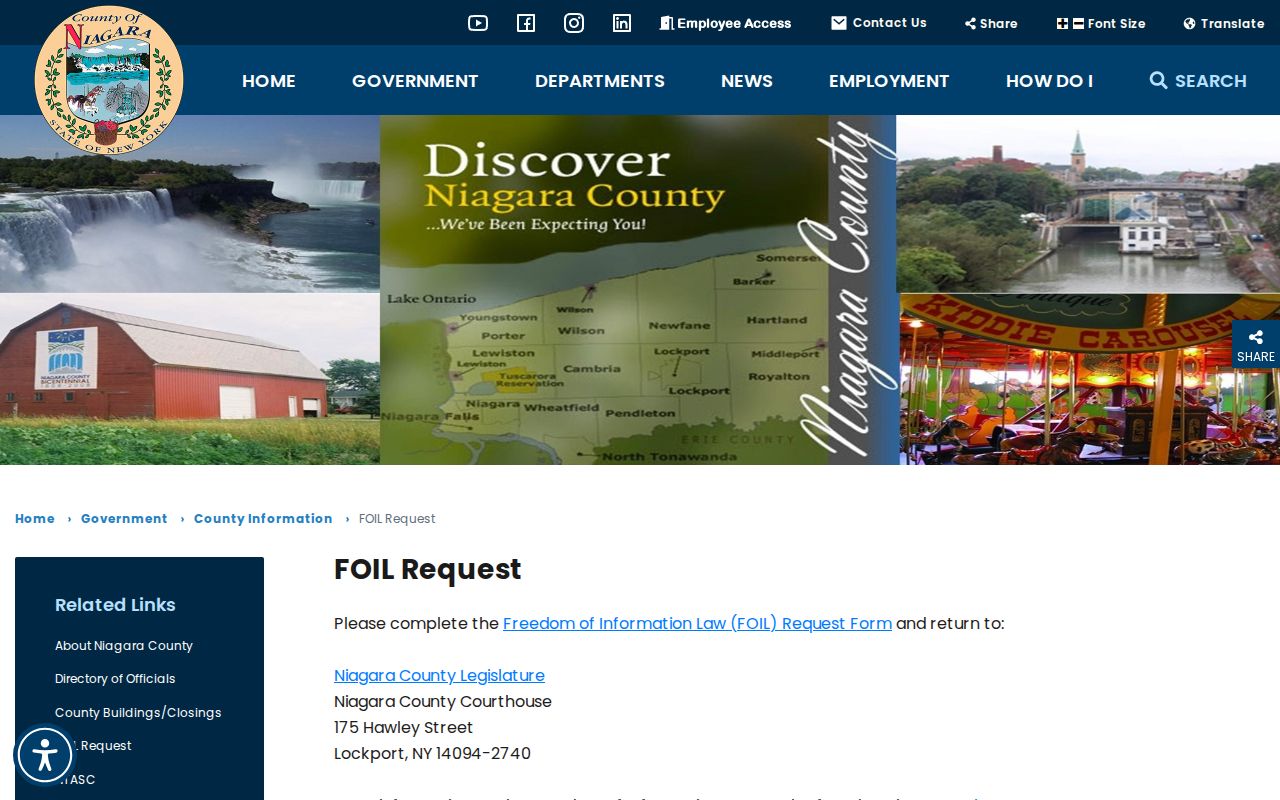
The FOIL image marks the county fallback. Send city police requests to the city that created the report, and use court procedures for court files. Police Records at the sheriff has direct lines for reports, 716-438-3416, and accidents, 716-438-3388.
Investigative, juvenile, victim, medical, and personal-identifier material can be redacted or withheld. A denial should state the ground and provide the applicable appeal path.
Sealed, Expunged, and Restricted Records
New York mainly uses record sealing. Favorable terminations may seal under CPL 160.50, youthful-offender records are confidential, and CPL 160.59 permits an application for certain older convictions. Clean Slate under CPL 160.57 directs automatic sealing after statutory waiting periods for eligible convictions. Some marijuana convictions are expunged by statute, but ordinary New York sealing does not mean that every copy is destroyed.
To correct Niagara County criminal history, obtain an unsuppressed DCJS Record Review and a certificate of disposition from each originating court. Then identify the applicable sealing path and file where the official court instructions direct. After an order is transmitted, check the DCJS response and public court interface again. If stale information remains, use the challenge instructions from DCJS with the disposition or sealing order.
Authorized criminal-justice bodies and certain agencies can retain access where a sealing law says so. Public systems may also take time to reflect a new order.
Federal Niagara County Criminal Records
Federal charges do not appear as Niagara County Court cases. Niagara County is in the Western District of New York, and the federal court provides an official court-access page for its Buffalo courthouse at 2 Niagara Square. PACER supplies federal dockets and filed documents after registration. Court opinions are free, while PACER generally charges by page subject to its quarterly waiver.
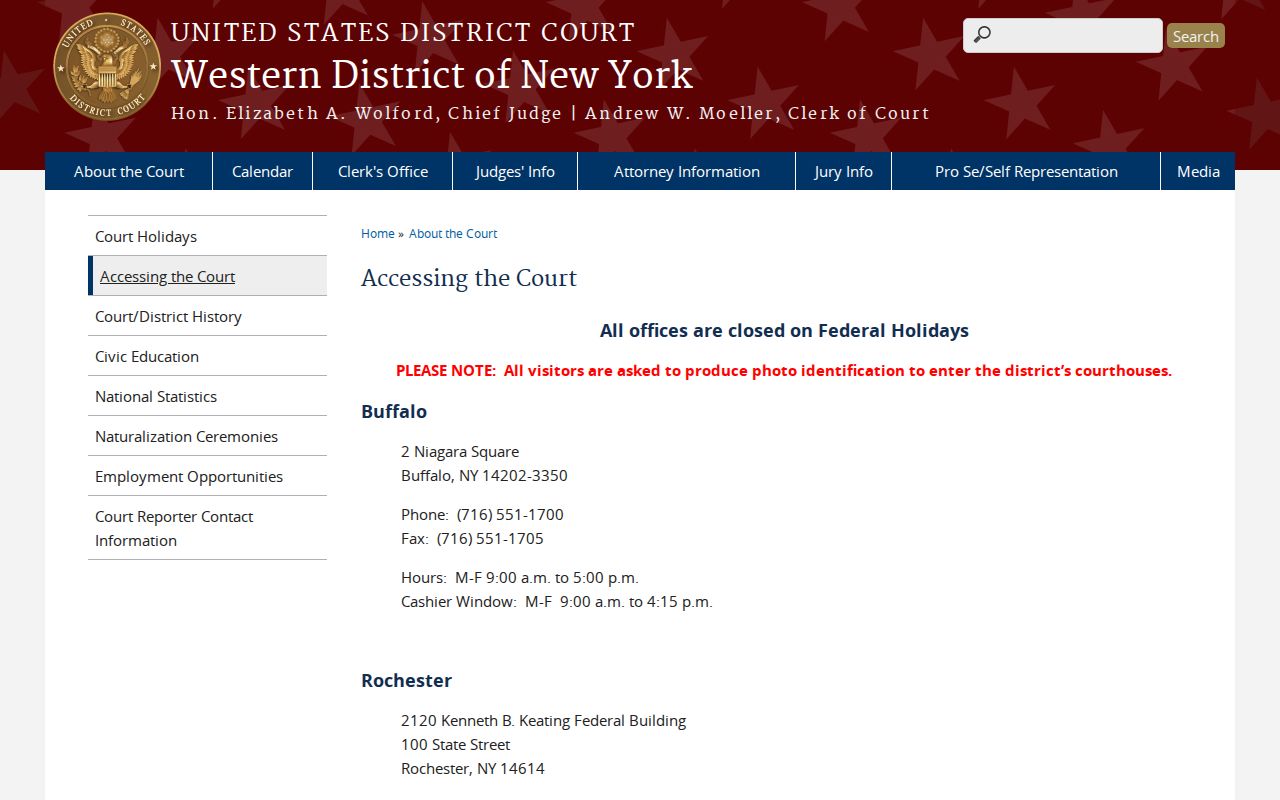
The federal-court image separates that docket from New York's county and city files. A personal FBI Identity History Summary is also separate. It is a fingerprint self-review, not a name search for someone else's record.
Niagara County Criminal Supervision Offices
Niagara County Probation supervises local court sentences under state oversight. DOCCS controls parole and post-release supervision, including service through the Niagara Frontier Area Office at 1905 Buffalo Avenue in Niagara Falls. The sentencing court's disposition can confirm that probation was imposed, but assessments, treatment notes, and detailed supervision files are not a general public lookup.
The Niagara County Public Defender maintains official access information for defense services in Lockport, Niagara Falls, and North Tonawanda.
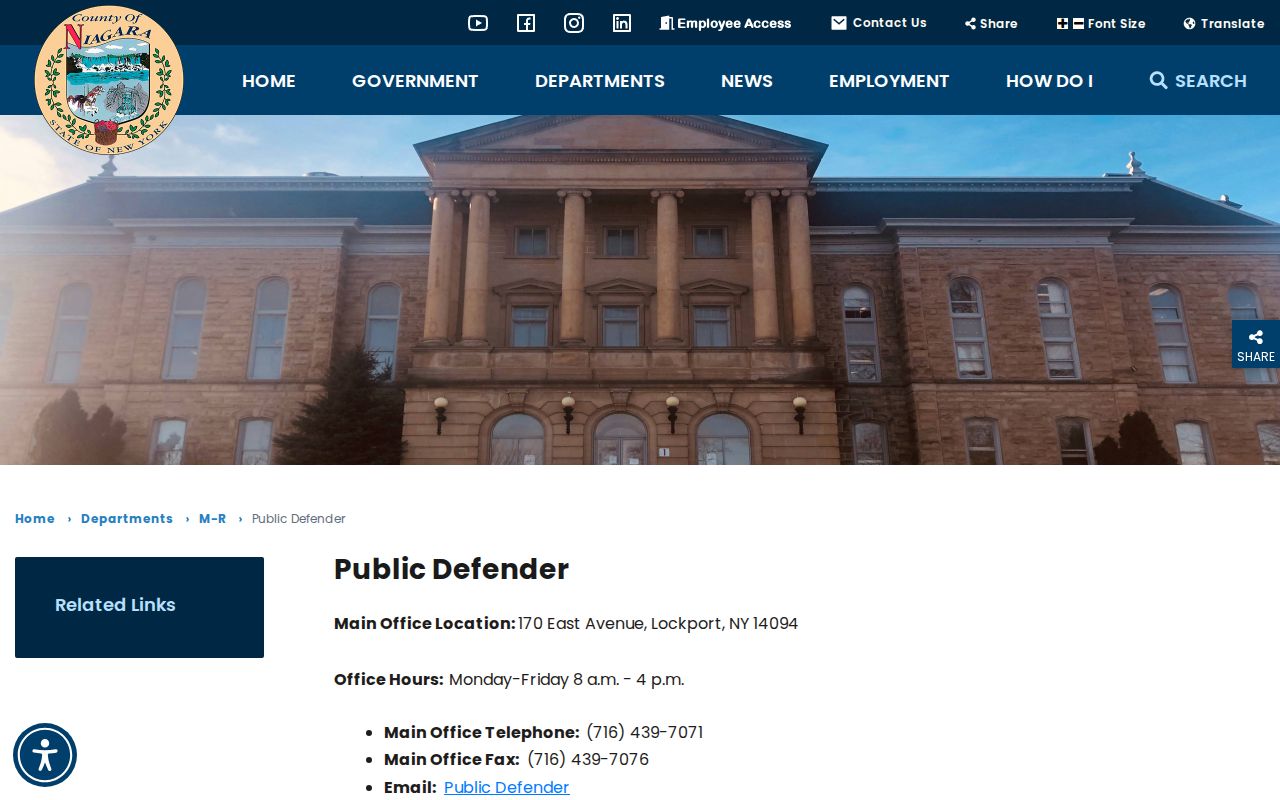
The Public Defender image reflects another office in the local case system. It is not a record repository, yet its locations explain why case-related services are split across Niagara County.
Niagara County Criminal Records by City
The three largest incorporated cities have separate police and City Court channels. Niagara Falls Police creates city incident reports while its City Court keeps misdemeanor and preliminary felony records. North Tonawanda Police and City Court share 216 Payne Avenue, but their files remain separate. Lockport's police, clerk, and City Court cluster at One Locks Plaza, while county felony files remain at Hawley Street.
Niagara Falls Criminal Records
Population estimate 47,255. Start with city police or City Court, then route a lodged booking to the county jail.
North Tonawanda Criminal Records
Population estimate 29,806. Police records and City Court share an address but use distinct request paths.
Lockport Criminal Records
Population estimate 20,248. One Locks Plaza holds city counters, not the County Court or jail records.