
Sex Offender Checks in Niagara County
The New York State Sex Offender Registry is the first official source for a Niagara County sex offender check. The Division of Criminal Justice Services, or DCJS, administers it under New York's Sex Offender Registration Act. The public online directory displays Level 2 and Level 3 registrants. It does not publish Level 1 profiles, and some older registrations are excluded due to federal litigation and due-process limits.
Use the Niagara County filter to survey listed Niagara County profiles, or use a last name or Niagara County ZIP code when the search is narrower. The Niagara County directory view is not a radius map. Its three search keys are alternatives, not fields that must all be filled. A searcher who needs Level 1 information should move to the registry telephone channel instead of treating an empty web result as a final answer.
The official New York registry screen shows the statewide source used for Niagara County searches.
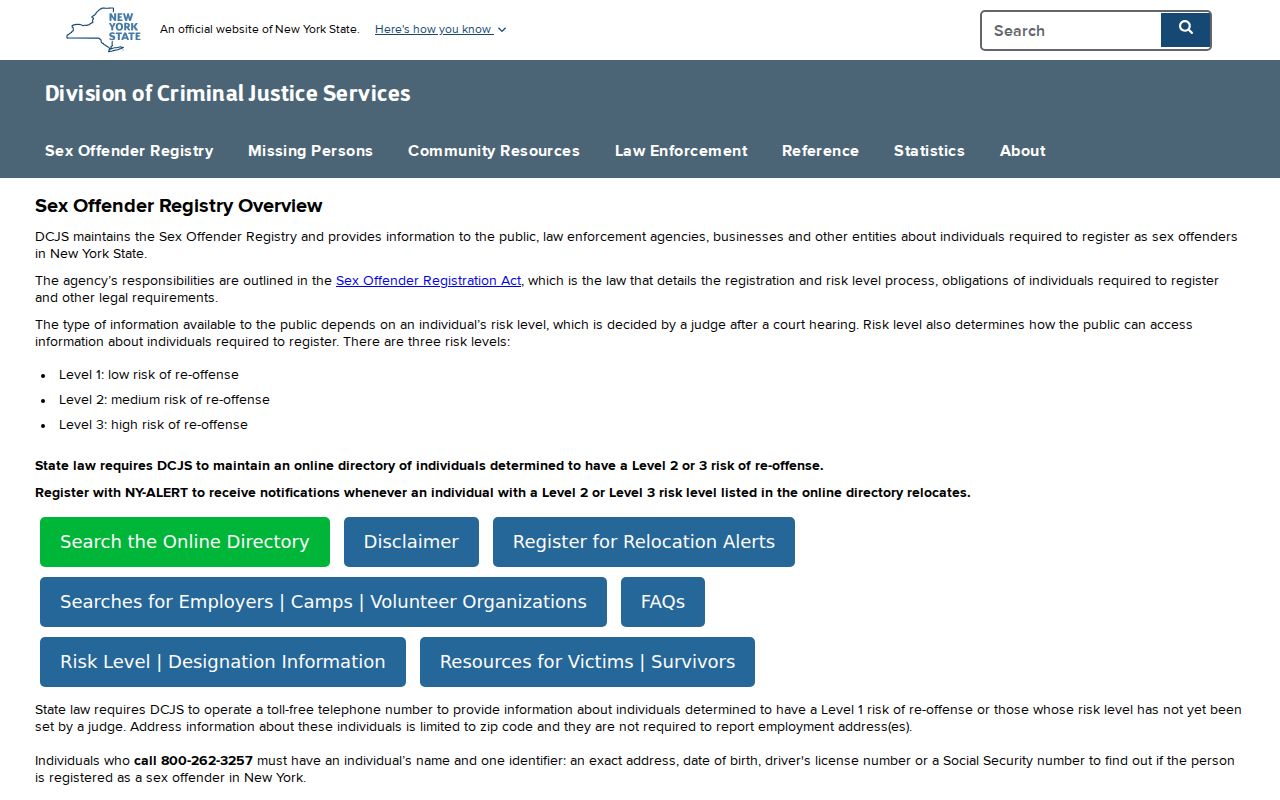
That state-run screen is the authoritative starting point for public Level 2 and Level 3 registry records in Niagara County.
Niagara County Level 1 Registry Calls
Niagara County Level 1 information uses the DCJS telephone registry because those profiles are not posted in the public directory. Call 518-457-5837 or 800-262-3257 and choose option 2. The Niagara County caller must provide the person's name plus one exact identifier: address, complete date of birth, driver-license number, or Social Security number. The line also covers Level 2, Level 3, and pending-level registrants.
Disclosure still varies by level. For a Level 1 registrant, the residence information is generally limited to a ZIP code. Complete residence addresses may be given for Level 2 and Level 3. This phone route closes a key gap in a Niagara County registry search, but it is not an open-ended name browse. Have a precise identifier ready before calling.
The DCJS registry information center explains why the web directory and phone service answer different questions.
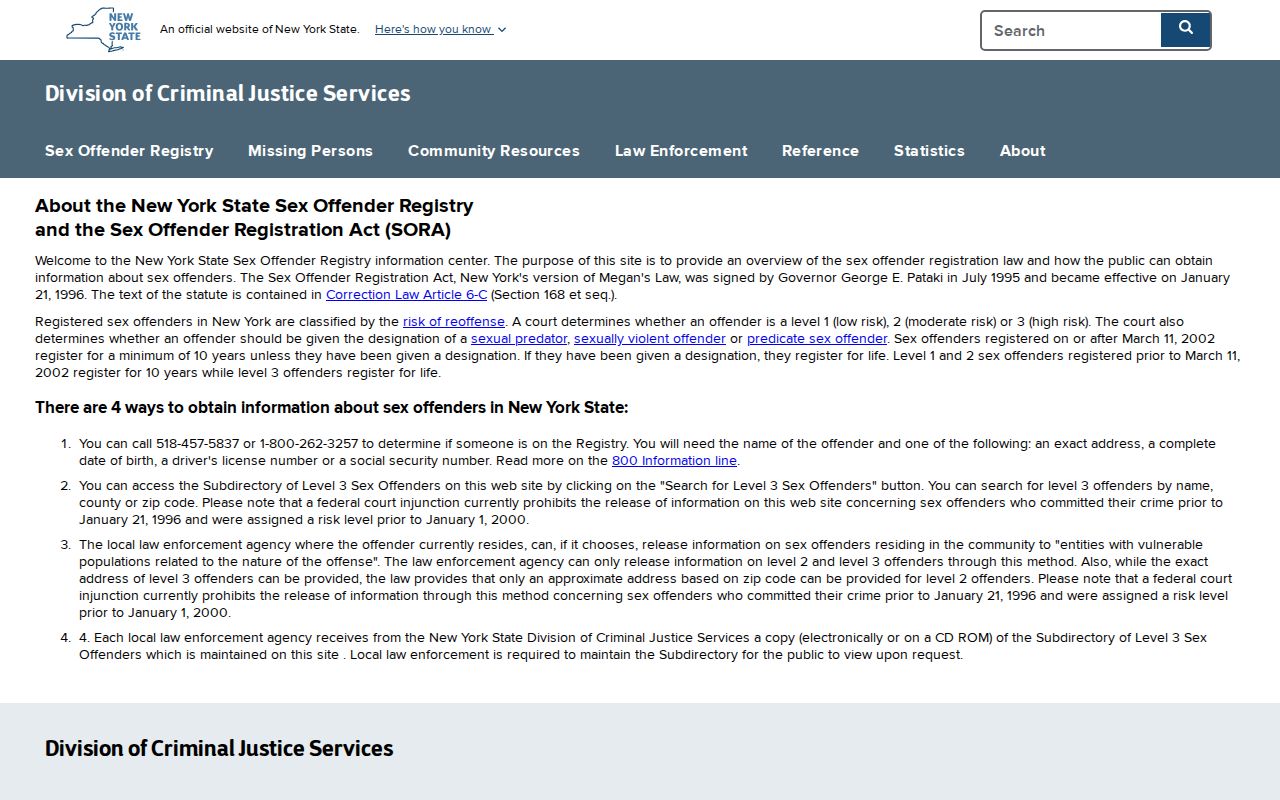
The information center is useful when a Niagara County online result is absent or when a risk level is still pending.
How to Search the New York State Sex Offender Registry
The public form is simple, but each choice changes the Niagara County scope. Select one search key and then review Niagara County matches carefully. Names can be shared, ZIP codes cross local boundaries, and a Niagara County search returns only the levels eligible for online disclosure.
- Open the official DCJS directory and read its conditions and limits.
- Enter one last name, choose Niagara County, or enter one five-digit ZIP code.
- Run the search and compare the displayed identity details before opening a profile.
- Read the full level, address, offense, status, and verification data, then use the phone line if Level 1 information is needed.
| Field label | Type | Required | Options and notes |
|---|---|---|---|
| Last Name | Text | One search key | Use instead of county or ZIP |
| County | Dropdown | One search key | Select Niagara from all New York counties |
| ZIP Code | Text | One search key | Enter a five-digit ZIP code |
| Search | Button | No | Runs the chosen query |
| Reset or Clear | Button | No | Clears entries where shown |
Note: The Niagara County directory search has no verified address-radius field, so do not treat it as a proximity map.
Missing Niagara County Registry Profiles
An absent profile does not prove that a person has no registration duty. New York withholds Level 1 entries from the public online directory. Pending-level cases may also require the phone channel. DCJS further notes that a federal injunction affects specified older registrations. These limits make the directory a defined public subset, not a full roster of every person known to the registry.
First, check spelling and whether the search used only one supported key. Next, call DCJS with the name and an accepted exact identifier. If the concern is a possible wrong address or missed move in Niagara County, report it to local law enforcement instead of trying to investigate or confront the person. DCJS and the agency with local jurisdiction can assess registration compliance.
The official registry questions and answers document these coverage limits and registration duties.
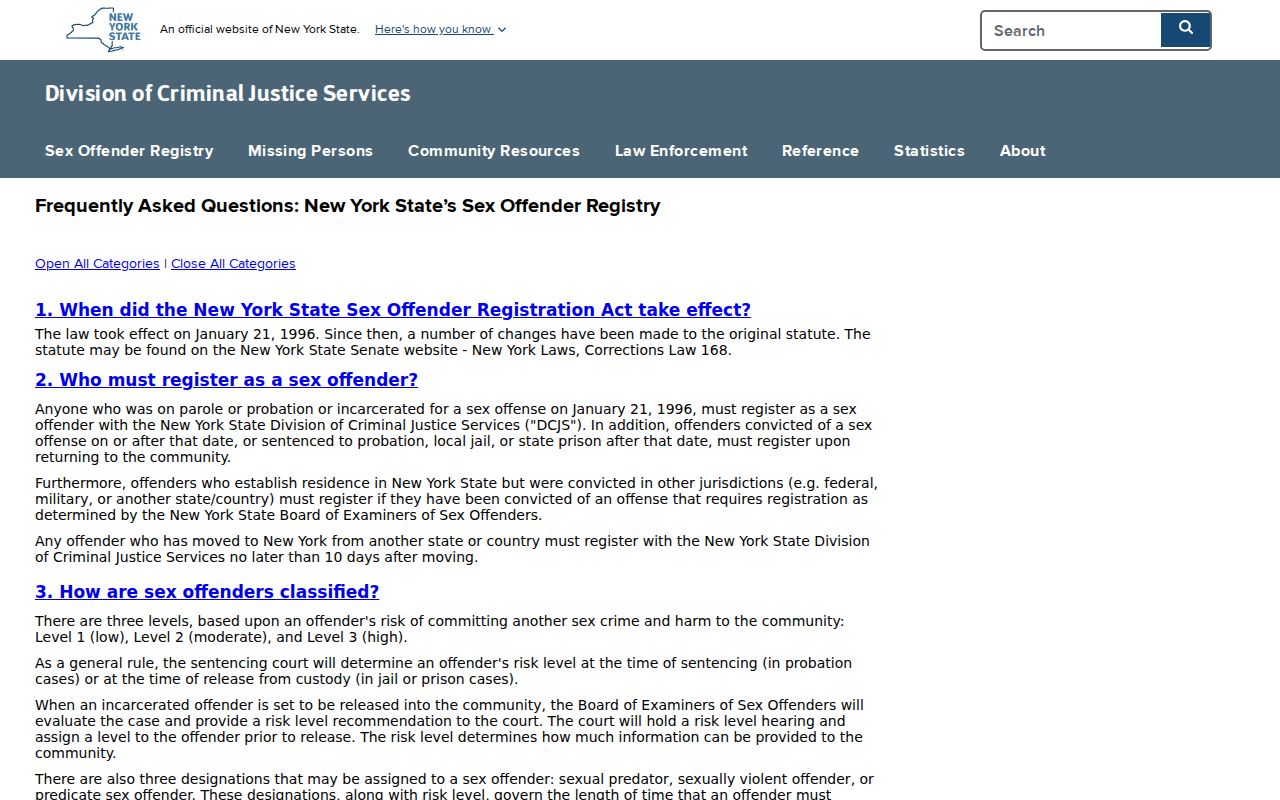
The state explanation helps distinguish a search limit from a claim about a person's legal status.
Inside a Registry Profile
A public registry profile combines identity, court, address, and compliance fields. Public disclosure depends on risk level and statute. Match several fields before drawing any conclusion, and note that the offense shown is the conviction that caused registration, not evidence of a new offense in Niagara County.
| Name and aliases | Identifying name and alternate names held by DCJS. |
|---|---|
| Photo and description | Photograph, age or birth information, height, weight, hair, eyes, and other identifying marks where disclosed. |
| Residence | Complete address for online Level 2 and Level 3 profiles; Level 1 phone disclosure is generally ZIP only. |
| Offense and case | Conviction offense, statute, jurisdiction, sentence information, and lawful victim or conduct details where available. |
| Risk and designation | Court-assigned level and any sexual predator, sexually violent offender, or predicate designation. |
| Status details | Compliance or address verification status, vehicle data, and school or higher-education links where authorized. |
Internet identifiers may be available to law enforcement without being part of ordinary public disclosure. A profile can also lag a recent move or court action, which is another reason to send suspected errors to the proper agency.
Niagara County Registry Verification Roles
DCJS runs the directory, but the law-enforcement agency with jurisdiction receives and verifies local registration information. The Niagara County Sheriff's Office contact directory lists Sex Offender Management at 716-438-3314. That line is the county contact supported by the official directory for local management questions. City police may be the right jurisdiction for an address inside a city.
Level 3 registrants and designated sexual predators personally verify their address every 90 days with local law enforcement. Other duties depend on Article 6-C. Registrants must sign and return annual verification within ten days of receipt and notify DCJS in writing no later than ten days after moving. A person who moves into New York from another state or country must register within ten days.
The official Sex Offender Registration Act materials place those duties in their legal setting.
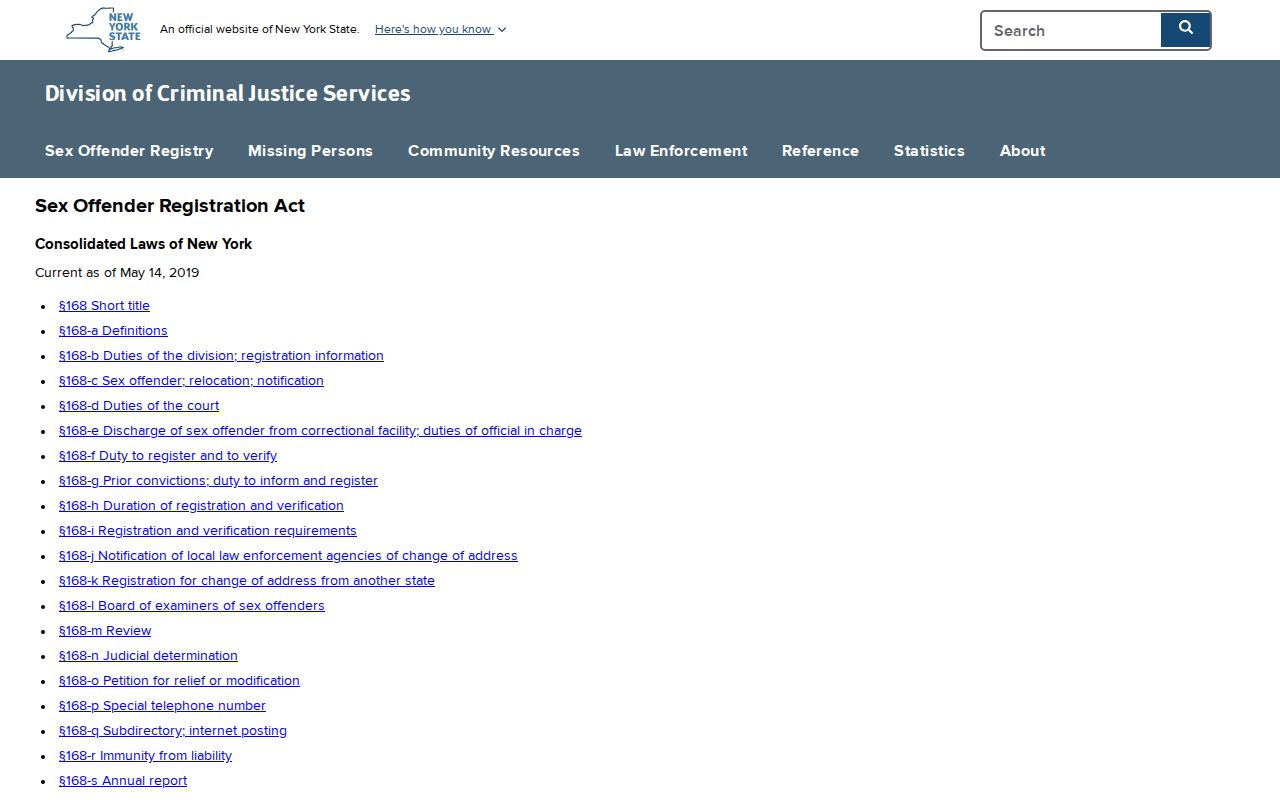
The statutory source separates Niagara County's verification work from DCJS publication and classification functions.
New York Registration Levels and Requirements
A judge assigns the risk level after a hearing. For an incarcerated registrant, the Board of Examiners of Sex Offenders reviews the case and recommends a level before release, but the court decides. Risk level estimates the risk of repeat offense and danger to public safety. It is not the degree of the conviction offense.
| Risk level | Duration without designation | Public access and verification |
|---|---|---|
| Level 1, low risk | 20 years; life with a qualifying designation | Not online; phone information available, with residence generally limited to ZIP |
| Level 2, moderate risk | Life; may petition after 30 years if no designation | Online and telephone |
| Level 3, high risk | Life | Online and telephone; address personally verified every 90 days |
The designations are separate from level. They can produce lifetime registration even where the ordinary Level 1 term is shorter. A Level 2 registrant without a designation may petition the sentencing or risk-level court under Correction Law §168-o after 30 years. Registrants and district attorneys may also seek a risk-level modification under that law.
The DCJS risk-level chart presents the official duration rules used for Niagara County registrants.
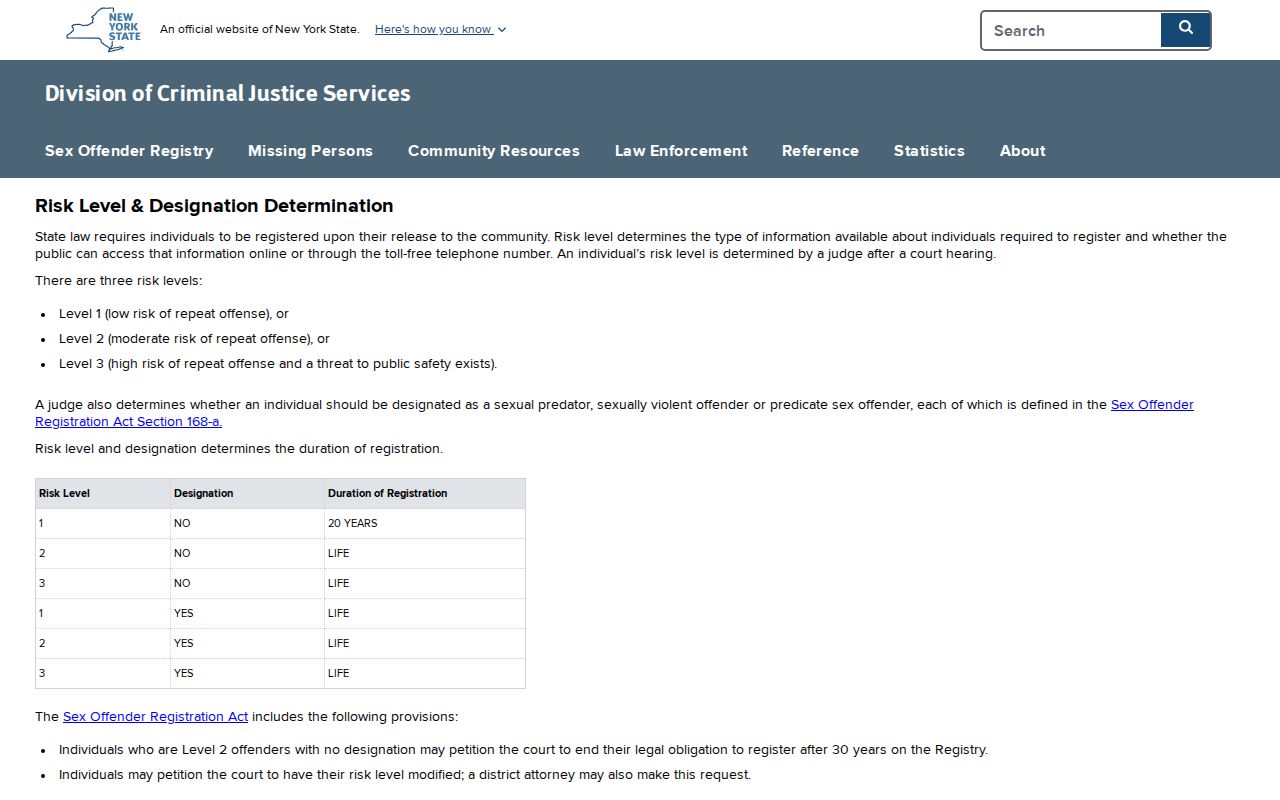
The chart makes clear why level, designation, duration, and public visibility must be read as separate profile facts.
Niagara County Registry Alerts
DCJS offers free email and text alerts for address-proximity information. Enrollment uses the registry information center's alert link and asks for the address to monitor plus a contact channel. Alerts add notice over time, while the directory answers a search made today. Neither replaces the telephone route for Level 1 information.
New York does not impose one simple statewide school or park distance ban on every registrant. A separate local rule or supervision condition would need its own support. For Niagara County safety planning, use the stated address and risk information, then rely on law enforcement for questions about compliance. Do not infer a violation from proximity alone.
The Niagara County Sheriff's Office website provides county contacts, while its official OCV app page supplies the sheriff's mobile route to sex-offender links and alerts.
Note: Address alerts are a monitoring aid, while DCJS and local law enforcement remain the sources for registry status and compliance.
Niagara County and the National Registry
The Dru Sjodin National Sex Offender Public Website, known as NSOPW, searches participating jurisdictions across state lines. It is helpful when a person may have moved, when an address is close to a state line, or when a safety check extends beyond Niagara County. The New York registry remains controlling for New York risk levels, designations, disclosure rules, and state notices.
Use the national result as a routing layer. Open the source-jurisdiction profile and read that jurisdiction's limits. Do not merge two people based only on a shared name. New York's online Level 1 limit also does not disappear merely because the search is national.
The official NSOPW search shows how the federal layer connects state and territorial public registries.
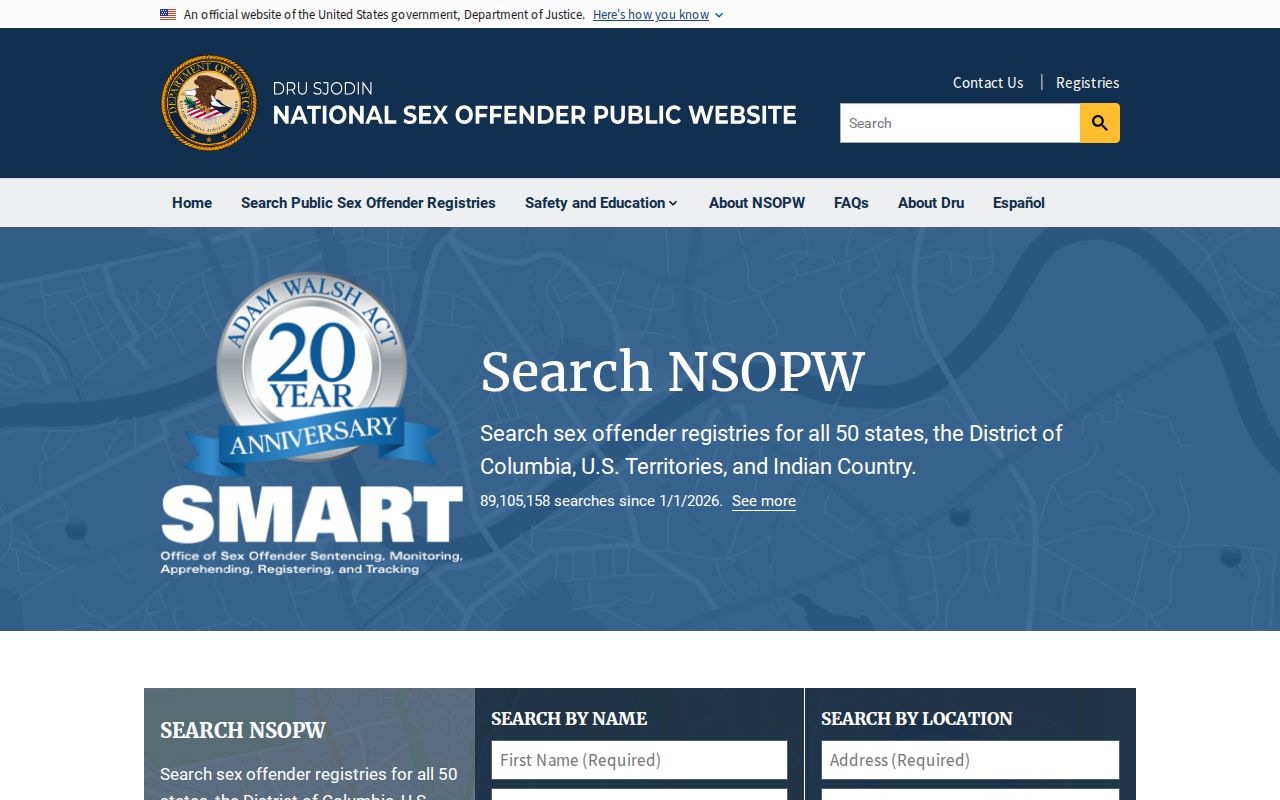
For a Niagara County result, return to DCJS or local law enforcement when classification, address verification, or phone-only disclosure matters.
Community Notification and Lawful Use
Registry data supports personal and community safety. Article 6-C permits disclosures tied to risk level, including notification to eligible organizations that serve vulnerable populations. Public users should read the stated conviction and risk information without treating it as proof of current misconduct. Suspected noncompliance belongs with Niagara County law enforcement or DCJS, not with a private confrontation.
Harassment, threats, intimidation, discrimination, and vigilantism can violate New York law and can hinder legitimate registry work. A delayed address or a profile that seems wrong should be reported with the specific reason for concern. The responsible step is to let the agency verify it.
Misuse is unlawful: New York's Sex Offender Registration Act, Correction Law Article 6-C, controls registry disclosure. Harassment, threats, intimidation, discrimination, and vigilantism can violate other criminal or civil laws. Never confront a Niagara County registrant or household.
Correction Law Article 6-C controls what may be released and to whom. It does not turn a profile into permission for retaliation or deny a person rights outside a specific legal rule.