
Niagara County Criminal Court Cases
New York divides Niagara County criminal work by court level. Niagara County Court at 175 Hawley Street in Lockport is the practical superior-court home for most felony prosecutions in Niagara County. New York Supreme Court also has general felony authority, but the state court system explains that County Courts generally handle criminal matters outside New York City. A Niagara County indictment or other superior-court action moves a felony beyond the local court that handled its first appearance.
Lockport, Niagara Falls, and North Tonawanda City Courts hear misdemeanors and violations within their cities. They also arraign felony complaints and conduct preliminary steps. Town Courts serve the same local role across Cambria, Lewiston, Hartland, Lockport, Newfane, Niagara, Pendleton, Porter, Royalton, Somerset, Wheatfield, and Wilson. Each Niagara County clerk keeps that court's file, so a broad request sent to one office will not collect every Niagara County criminal case.
Niagara County Court at Hawley
The Niagara County Clerk criminal record form is the most concrete Niagara County route for County Court documents. The official form offers a certificate of disposition for $5, a docket summary for $5, or a named document at a page-based cost. Staff ask requesters to call 716-439-7022 before paying for a specific document. The docket summary is a list of the documents available in the case; it is not the same product as the certified statement of outcome.
The Niagara County form asks for a defendant name, indictment, arrest date, charges, conviction date, sentence date, and ticket number. It also requires the requester's name, signature, and contact phone. Mail the form, a check payable to Niagara County Clerk, and a self-addressed stamped envelope to 175 Hawley Street, Lockport, NY 14094. Requests without that return envelope are not processed. The first-floor counter is open weekdays from 9:00 a.m. to 5:00 p.m.
The official Niagara County courts directory shows how many separate venues can hold a case.
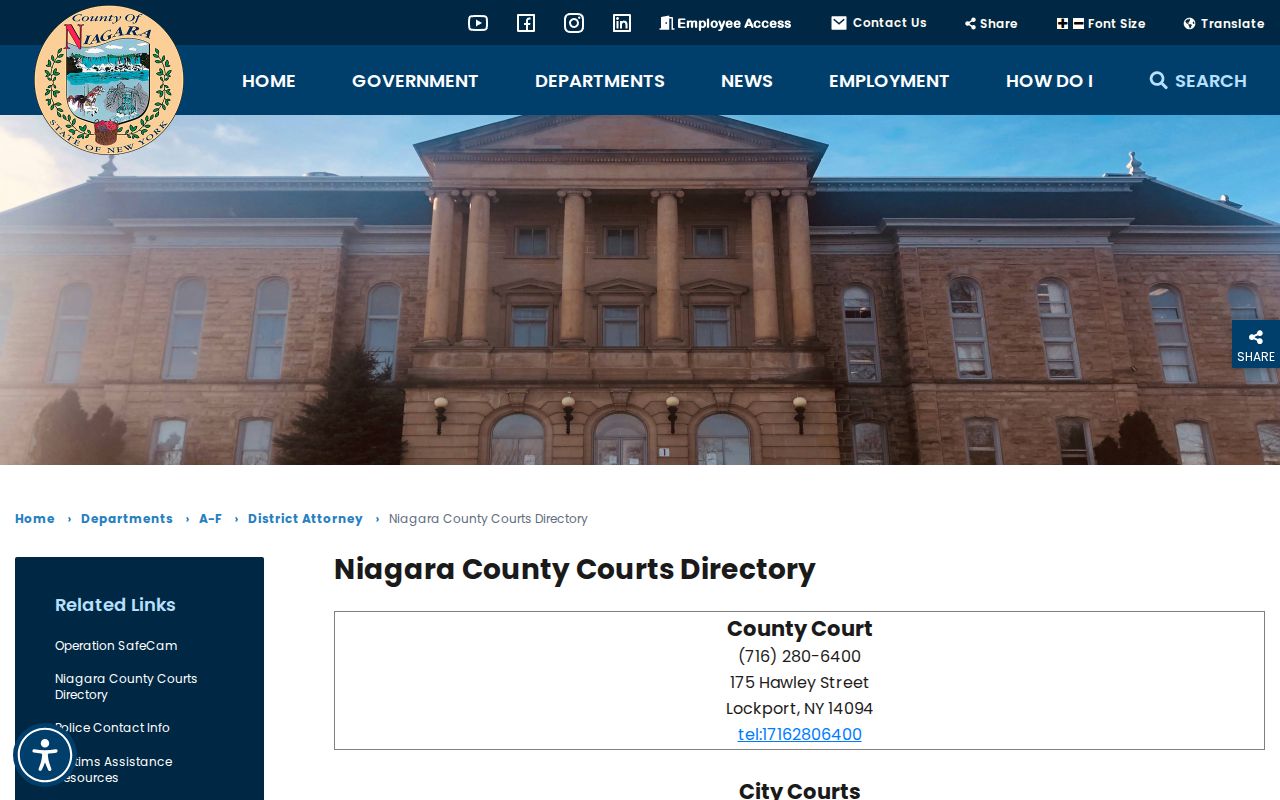
That Niagara County directory is a routing aid; the Niagara County clerk for the court that heard the matter remains the record custodian.
Searching Niagara County Case Records
Niagara County does not publish one complete, free, anonymous database for all local criminal files. WebCriminal can show covered calendars and public case information, but it is not a full document store. NYSCEF is an e-filing service with account and coverage limits. The dependable Niagara County path is to identify the venue, use online information as a lead, then ask that clerk for the exact product.
- Identify the city, town, or superior court from the appearance ticket, complaint, indictment, or known hearing location.
- Check New York WebCriminal for covered public calendar information, using the name and court details you know.
- Call the court clerk to confirm that the office holds the case and to ask which identifiers will locate it.
- Choose a docket summary, certificate of disposition, or specific filed document instead of asking broadly for a background record.
- Submit the local clerk's request with the required contact details, payment, identification, authorization, and return envelope that apply.
For a County Court file, the local request form supplies the most useful field inventory:
| Field Label | Type | Required | Notes |
|---|---|---|---|
| Defendant Name | Text | Not expressly | Complete as many fields as possible |
| Indictment | Text | No | Superior-court identifier when known |
| Date of Arrest | Date | No | Useful search clue; no format printed |
| Charges | Text | No | Free-form description |
| Conviction or Sentence Date | Date | No | Later outcome dates |
| Ticket Number | Text | No | Useful local identifier when applicable |
| Contact Phone | Telephone | Yes | Lets staff resolve request questions |
Niagara City Court Records Compared
The three Niagara County City Courts have separate counters and files. Niagara Falls City Court is at 1925 Main Street and can be reached at 716-371-4100. North Tonawanda City Court shares 216 Payne Avenue with City Hall and uses 716-845-7240. Lockport City Court is at One Locks Plaza and uses 716-280-6205, with a separate criminal line at 716-280-6227.
These courts handle misdemeanor and violation cases, certificates of disposition, sealing work, and felony preliminary proceedings. A felony arraignment in City Court does not mean that court will hold the later indictment file. Once a Niagara County felony reaches County Court, the superior-court record belongs at Hawley Street. No official City Court page inspected for this research offered an anonymous public name-search form, so phone, written request, and the clerk counter are the sound fallbacks.
Note: EDDS delivers papers to participating courts; it is not a public Niagara County criminal-record name search.
Inside a Niagara County Case File
A court file follows litigation, not just the first arrest. It may contain the accusatory instrument, appearances, motions, pleas, orders, judgment, fines, and sentence. The County Clerk request separates arrest date and charges from conviction and sentence dates, which helps show that an allegation can change before a final result. A certificate of disposition is the originating court's certified statement of the outcome; an OCA name search or calendar result is not a substitute.
| Case Number and Court | The court-controlled identifier and venue; the format varies by court. |
|---|---|
| Charging Document | The complaint, information, or indictment that formally states charges. |
| Docket Entries | A dated record of filings, appearances, motions, orders, and other activity. |
| Hearing Dates | Scheduled or completed arraignments, conferences, hearings, trial dates, and sentencing. |
| Disposition and Judgment | The outcome of each charge, such as conviction, dismissal, or acquittal. |
| Sentence and Conditions | The court-ordered consequence after conviction, including fines or supervision when imposed. |
Niagara County Disposition Requests
Choose the record product based on the question. A certificate of disposition is best when a certified outcome is needed. A docket summary helps identify what the court file contains before ordering copies. A plain copy reproduces a selected filed paper but does not carry the same certification as an official disposition. Niagara County prices the first two County Court products at $5 each, while the cost of a specific document depends on its pages.
Lockport City Court uses its own detailed certificate request. That form asks for requester contact information, the requester's relationship to the defendant, identification, and delivery by pickup or self-addressed stamped envelope. A person asking for material that may be sealed under the listed criminal procedure provisions needs written authorization. Some requests may be referred to OCA's Criminal History Record Search Unit. Use the official Lockport disposition form for that court, not the County Clerk form.
How a Criminal Case Moves
A local criminal case begins with an accusatory instrument and arraignment. Misdemeanor and violation cases may remain in a City or Town Court through motions, plea, trial, and disposition. A felony complaint begins in a local criminal court, but an indictment moves the prosecution to Niagara County Court or another superior court. The file at each stage reflects what that court did, which is why one name can be tied to records in more than one Niagara County clerk's office.
Case flow: Charges Filed › Arraignment › Pretrial › Plea or Trial › Disposition › Sentencing
After sentencing, later motions, sealing orders, and appeals can change which record is visible or where the next filing is kept. The court of origin remains the right place to verify its disposition.
Reading Niagara County Case Outcomes
“Pending” or “open” means the prosecution has not reached a final disposition. “Convicted” means guilt was established by plea or verdict and judgment was entered. A dismissal ends one or more charges without conviction, while an acquittal is a not-guilty verdict after trial. An adjournment in contemplation of dismissal pauses a case under set terms and leads to dismissal if the statutory requirements are met.
- Arraignment
- The court appearance when charges are stated and a plea is taken.
- Indictment
- A grand-jury accusation that authorizes felony prosecution in superior court.
- Disposition
- The result of a charge or case, such as conviction, dismissal, or acquittal.
- Certificate of disposition
- The originating court's certified statement of the case outcome.
- Bench warrant
- A judge-issued warrant often based on a failure to appear or obey a court directive.
A court outcome should be checked at the originating court even when a separate arrest, jail, or DCJS record still shows an earlier charge.
Older Niagara County Court Files
Online gaps do not prove that an older Niagara County case never existed. WebCriminal is a calendar and covered-case tool, not a full archive. County record links presented with subscription and land-record resources should not be treated as a complete free criminal search. A name variation, old local docket, reporting delay, or court transfer can also break the online trail.
Call the suspected clerk with the person's full name, known arrest or filing date, charge, ticket number, indictment number, and any old paperwork. The New York courts record guide directs requesters back to the court that keeps the file. For County Court, use the Hawley Street form. For a City or Town Court matter, ask that local clerk about its search, copy, and certification process before sending funds.
Case Record Access & Restrictions
Judiciary Law section 255 requires clerks to search files and provide copies or certifications after lawful fees unless another law makes the record confidential. Local justice-court access also respects favorable-termination sealing and youthful-offender confidentiality. Public access therefore does not reach every Niagara County court record.
The County Clerk form states that victim-identifying and personal or medical details are redacted. It cannot be used for a sealed or youthful-offender file. A defendant or attorney needs a notarized written request for access allowed in that role. Grand-jury material is secret and is not released through an ordinary document request. Sealed cases, juvenile matters, and other protected details do not become open merely because someone files a New York Freedom of Information Law request.
If a case that should be sealed remains visible, obtain a personal DCJS Record Review and a certificate of disposition, then contact the court that issued the outcome. The broader Niagara County criminal history overview explains why court, police, jail, and state records may not update at the same time.